LymphActiv ingredients: the full formula and the official label
Two capsules of LymphActiv contain 360 mg of red vine leaf extract, 300 mg of dandelion leaf extract, 200 mg of bromelain, 150 mg of maritime pine bark extract, 100 mg of horse chestnut seed extract, 80 mg of vitamin C and 12 mg of vitamin E. Every amount is printed on the English label, which matches the formula sold in the UK. Below you will find the full table, the label itself, each ingredient in turn, what is not in the capsules and how UK rules frame what we can say.
The LymphActiv ingredient table
LymphActiv combines five plant extracts and two vitamins, with the amounts below for the daily serving of 2 capsules. One bottle holds 60 capsules, so 30 servings.
| Ingredient | Per 2 capsules | Standardisation | % NRV |
|---|---|---|---|
| Red vine leaf extract (Vitis vinifera) | 360 mg | leaf extract | none set |
| Dandelion leaf extract (Taraxacum officinale) | 300 mg | leaf extract | none set |
| Bromelain | 200 mg | 1200 GDU/g, so 240 GDU | none set |
| Maritime pine bark extract (Pinus pinaster) | 150 mg | 95 % OPCs, so 142.5 mg of OPCs | none set |
| Horse chestnut seed extract (Aesculus hippocastanum) | 100 mg | 20 % aescin, so 20 mg of aescin | none set |
| Vitamin C (L-ascorbic acid) | 80 mg | not applicable | 100 % |
| Vitamin E (DL-alpha-tocopheryl acetate) | 12 mg | not applicable | 100 % |
NRV stands for Nutrient Reference Value, the reference intake used on UK and EU labels. There is no NRV for plant extracts or enzymes, which is why only the vitamins have a percentage. To see what a daily serving costs, visit our LymphActiv price page.
The official LymphActiv label
This is the English label of LymphActiv, the reference for every figure on this website. Check it against any product sold under the same name.
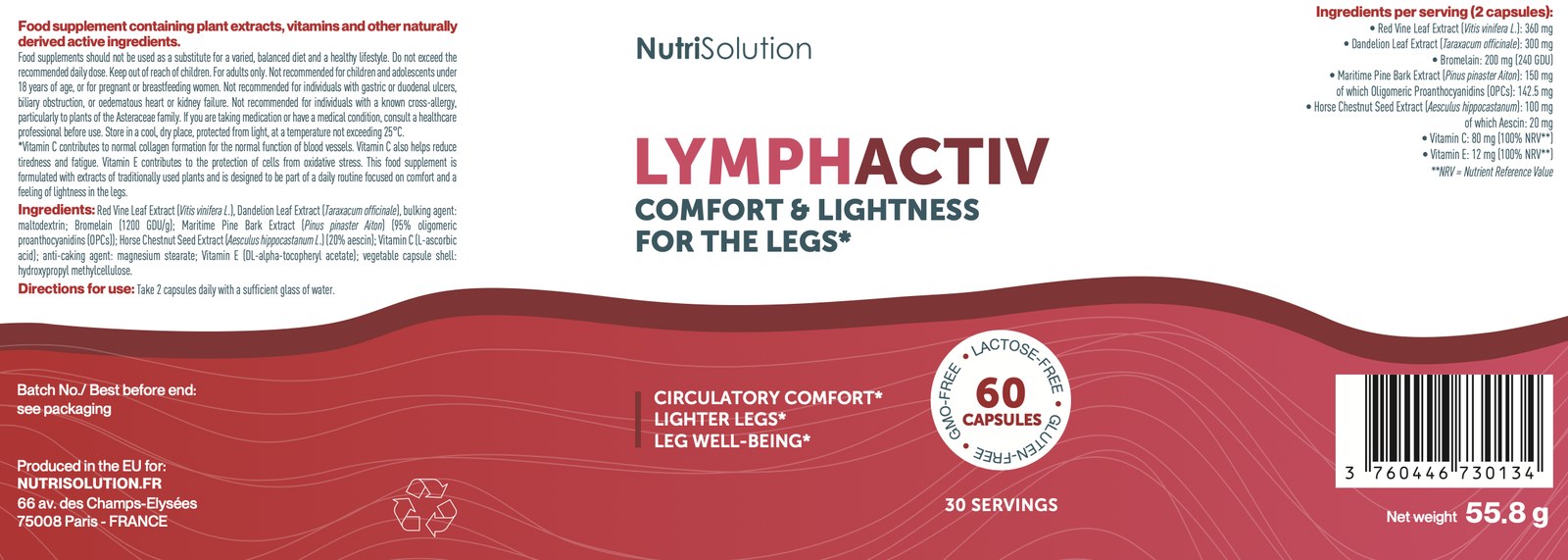
The label lists the ingredients in descending order of weight, the amounts per 2 capsules, the directions (2 capsules daily with a sufficient glass of water), the warnings, the net weight (55.8 g) and the barcode (GTIN 3760446730134). The capsules are produced in the EU for Nutrisolution, 66 avenue des Champs-Élysées, Paris. The words on the front of the bottle carry an asterisk: it refers to the statements on vitamins C and E printed on the back, which are the only health claims the product makes.
The seven ingredients, one by one
Each ingredient has its own page with the research, its limits and its precautions. Here is the short version.
Red vine leaf extract, 360 mg
Leaves of red grape varieties, rich in flavonoids such as quercetin derivatives, with a long history in European herbal use. The European Medicines Agency has published an assessment of red vine leaf as a traditional herbal substance. Trials exist on one specific standardised extract at 360 or 720 mg a day; ours is a different extract, so those results cannot be transferred directly. Read more about red vine leaf.
Dandelion leaf extract, 300 mg
The leaf of the common dandelion, used traditionally across Europe and assessed by the EMA as a herbal substance. Human studies on the leaf are few and small. Dandelion belongs to the Asteraceae (daisy) family. Read more about dandelion.
Bromelain, 200 mg
A mixture of protein digesting enzymes extracted from the pineapple plant. Its activity is measured in GDU (gelatin digesting units): 200 mg at 1200 GDU/g gives 240 GDU per serving. Research covers several areas, with studies that are often small and results that vary. Read more about bromelain.
Maritime pine bark extract, 150 mg
Bark of the maritime pine from south west France, concentrated to 95 % oligomeric proanthocyanidins (OPCs), so 142.5 mg of OPCs a day. Pine bark extracts have been studied in a range of small trials whose quality is uneven, as independent reviews point out. Read more about maritime pine bark.
Horse chestnut seed extract, 100 mg
Extract from the seed of the horse chestnut tree, standardised to 20 % aescin, so 20 mg of aescin a day. A Cochrane review has looked at horse chestnut seed extract in people with chronic venous insufficiency, a medical condition. Those trials used higher doses of aescin, typically 100 to 150 mg a day, so they say nothing direct about LymphActiv. Read more about horse chestnut.
Vitamin C, 80 mg, and vitamin E, 12 mg
The two ingredients with authorised health claims. Vitamin C contributes to normal collagen formation for the normal function of blood vessels, to the reduction of tiredness and fatigue and to the protection of cells from oxidative stress. Vitamin E contributes to the protection of cells from oxidative stress. Each is present at 100 % of the NRV. Read more about vitamins C and E.
What does "standardised" mean on the label?
A standardised extract guarantees a minimum content of a key compound, so the dose is the same from one batch to the next. In LymphActiv, that applies to maritime pine bark (95 % OPCs) and horse chestnut (20 % aescin).
A plain plant powder can vary a great deal depending on harvest, soil and weather. Standardisation fixes the content of the compound most associated with the plant in the literature. It is also what lets you compare a supplement with the doses used in studies, which is exactly why we tell you that our 20 mg of aescin is lower than the amounts tested in the Cochrane review. For bromelain, the equivalent measure is enzyme activity, expressed in GDU.
What is not in LymphActiv?
According to its label, LymphActiv is lactose free, gluten free and GMO free. Its ingredient list contains no caffeine, no hormones and no medicinal substances.
It also contains no diuretic medicine or laxative, and no ingredient presented as a weight loss aid. LymphActiv is not a medicine: it is not meant to treat, prevent or cure any disease, and it does not replace treatment prescribed by your GP or a specialist, including compression stockings. If you are unsure whether it is compatible with your treatment, see our page on side effects and precautions.
Capsule, excipients and allergies
The capsule shell is made of HPMC (hydroxypropyl methylcellulose), a plant based material, and the only excipients are maltodextrin and magnesium stearate. The label states that the product is lactose free, gluten free and GMO free.
- Maltodextrin is a bulking agent derived from starch, used in small amounts to fill the capsules evenly.
- Magnesium stearate is an anti caking agent that keeps the powder flowing during manufacture.
- Allergies: the label warns against use in case of a known cross allergy, particularly to plants of the Asteraceae family (dandelion, daisy, ragweed, chamomile). Bromelain comes from pineapple; if you have reacted to pineapple, ask a pharmacist before trying it.
For how many capsules to take and when, see how to take LymphActiv.
UK rules for food supplements
In the UK, food supplements are regulated as foods, not medicines, and only authorised nutrition and health claims may be used. That is why our claims are limited to vitamins C and E.
Food supplements sold in Great Britain must comply with the Food Supplements Regulations and with the GB nutrition and health claims register, overseen by the Food Standards Agency and enforced by local trading standards. Advertising must follow the CAP Code, enforced by the ASA. You may notice that some horse chestnut or red vine leaf products in UK chemists are registered with the MHRA as traditional herbal medicines: they follow a different set of rules, with their own doses and indications. LymphActiv is not one of them; it is a food supplement.
Frequently asked questions about the ingredients
Is LymphActiv suitable for vegetarians and vegans?
The capsule shell is plant based (HPMC) and the active ingredients come from plants or are vitamins. The label does not carry a vegetarian or vegan certification, and the origin of an excipient such as magnesium stearate is not stated on it, so if this matters to you, check with Nutrisolution's customer service.
How does LymphActiv compare with horse chestnut tablets from a UK chemist?
Horse chestnut products registered with the MHRA as traditional herbal medicines usually contain more aescin than LymphActiv's 20 mg and follow medicine rules. LymphActiv is a food supplement that combines five plant extracts with vitamins C and E. Ask your pharmacist before combining the two.
Can I take LymphActiv with a multivitamin?
Usually yes, but add up the vitamins: LymphActiv already provides 100 % of the NRV for vitamins C and E. Both remain well below the safe upper levels set by UK and European experts at these amounts. Ask a pharmacist if you take several supplements.
Does LymphActiv contain caffeine?
No. None of the seven ingredients is a source of caffeine, so you can take your capsules in the evening if that suits your routine better.
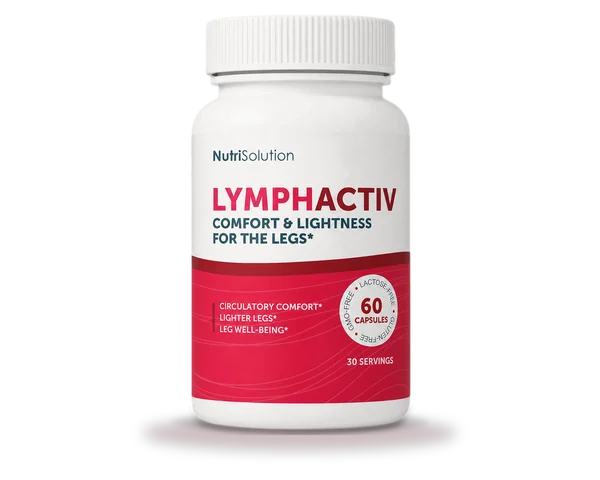
LymphActiv: 7 ingredients, 2 capsules a day
- Red vine leaf (360 mg), dandelion (300 mg), bromelain (200 mg)
- Maritime pine bark (142.5 mg OPC) and horse chestnut (20 mg aescin)
- Vitamin C, which contributes to normal collagen formation for the normal function of blood vessels, and vitamin E
- 180-day money-back guarantee, only through the official order page
Sources
- Official LymphActiv label (English version): ingredients, amounts per 2 capsules, warnings.
- Department of Health and Social Care, Great Britain nutrition and health claims (NHC) register.
- Food Standards Agency, food supplements guidance.
- European Medicines Agency, Committee on Herbal Medicinal Products (HMPC): assessments of Vitis vinifera folium, Taraxacum officinale folium and Aesculus hippocastanum semen.
- Pittler MH, Ernst E. Horse chestnut seed extract for chronic venous insufficiency. Cochrane Database of Systematic Reviews, 2012.
- MHRA, Traditional Herbal Registration scheme.
- Committee of Advertising Practice, CAP Code, section 15.